
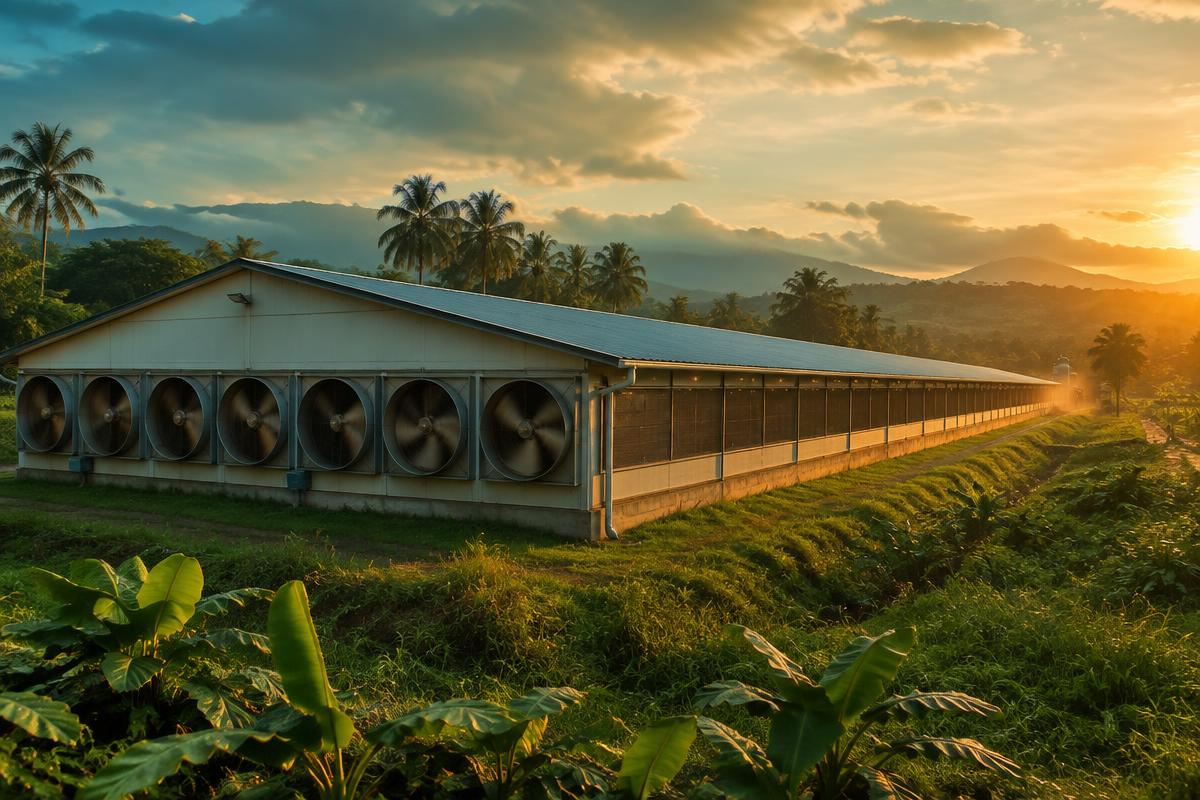
A tropical house is often judged on its hottest afternoon, but its resilience is built weeks earlier. Bird density, fan maintenance, cooling-pad condition, generator testing and water storage determine whether the system has room to respond.
Field principle
Ventilation capacity on paper is not air speed over birds. Leaks, dirty shutters, loose belts and poor inlet control can consume the margin.
Start with the bird-level outcome
Measure conditions where birds live, not only at the controller. Look for uneven distribution, panting, wing spreading and crowding near air inlets or drinkers. Humidity changes how evaporative cooling performs, so temperature alone is incomplete.
As birds grow, metabolic heat rises while floor area does not. A placement density that appears comfortable early can leave little safety margin near market weight. Check the legal and contract limits that apply locally, then plan below the binding constraint when heat risk warrants it.
Plan for the failure state
List what happens when mains power, a pump, a controller or a fan bank fails. Test alarms and backup generation under load, not merely at idle. Confirm someone can respond at the hour when the site is least staffed.
Jamaica and other hot-humid markets are useful examples, but tropical design is not one regional template. Coastal humidity, altitude, power reliability and water quality can change the correct system within the same country.