
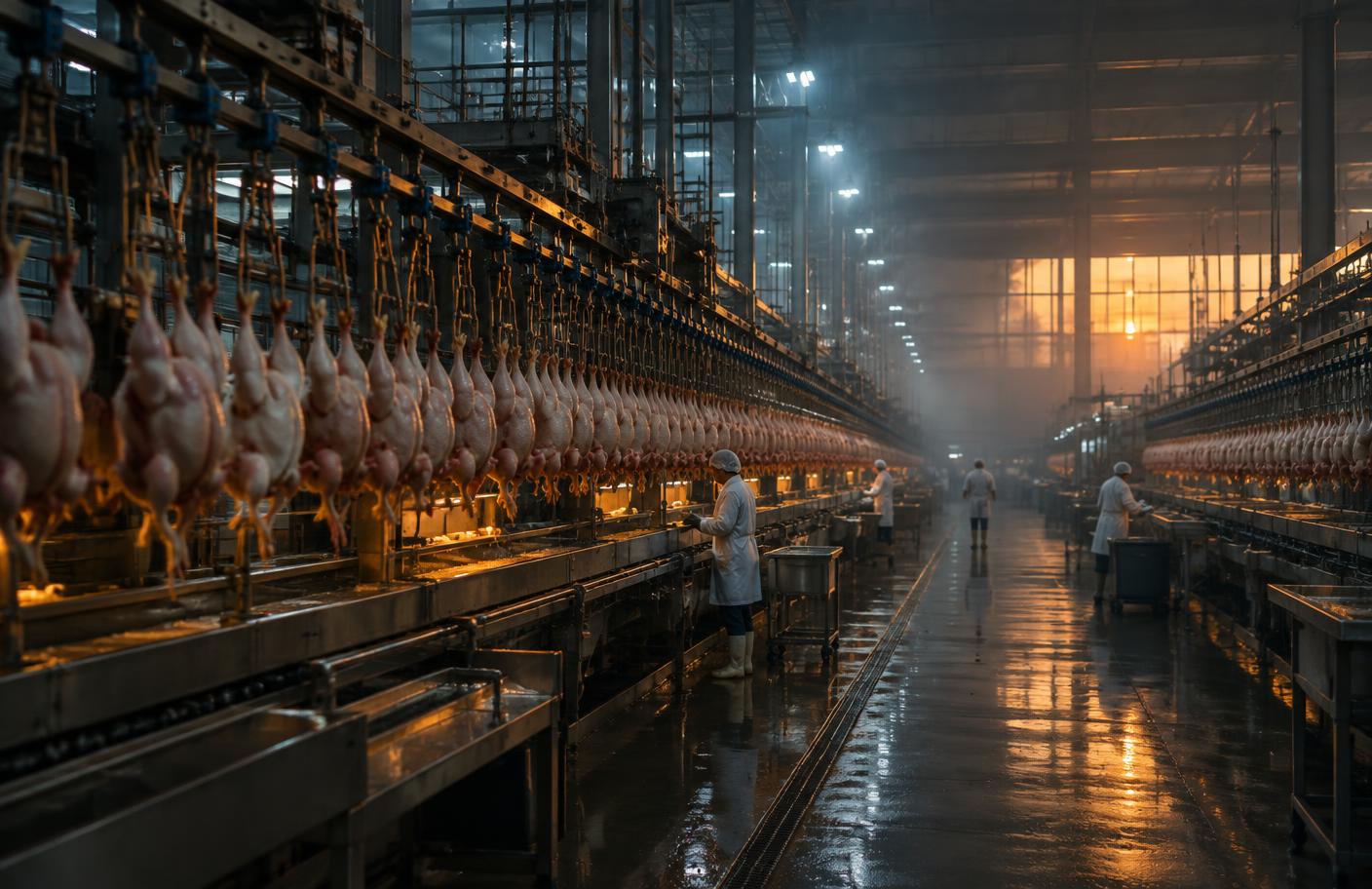
It is tempting to assume the largest broiler companies win because they are better at raising chickens. They are not, particularly. They win because they have mastered three things that sit around the chicken rather than inside it: buying and moving grain at scale, deploying capital faster than competitors, and selling every part of the bird into the market that pays most for it. The good news for everyone else is that the playbook for a small or medium producer is not a shrunken copy of the titan's game. It is a different game entirely—and it is winnable.
Field principle
The titan's advantage is structural and cannot be copied; the independent's advantage is local and cannot be taken—cost per kilo, a buyer who values you, and numbers you actually know.
What actually makes a titan
Start with feed. Feed is roughly sixty to seventy percent of the cost of a broiler, so the firms that sit closest to cheap maize and soya start with an advantage no management skill can replicate. The United States and Brazil dominate not because their farmers are uniquely gifted but because they sit on two of the world's great grain belts, with rivers, railways and ports built to move it. Weather matters mostly through this channel: a drought in the US Midwest or a failed Brazilian safrinha crop moves feed costs for every producer on earth, but it moves them least for the firms that own the mills, the silos and the freight.
The second ingredient is capital. A modern processing plant, a feed mill and a hatchery network cost hundreds of millions; the titans can build them, idle them, or buy a competitor outright when prices dip. The third is carcase balance—the least visible and possibly the most decisive. A chicken is breasts, legs, wings, feet and fat, and no single market wants them in the proportions a bird provides. The giants make their margin by selling each part where it is worth most: breast to Europe and North America, leg quarters to Africa and Latin America, feet and paws to Asia, rendered fat to feed and fuel. A company that can only sell whole birds into one market is playing a far weaker hand.
Market size cuts both ways
A large domestic market is a real advantage—the US industry was built on one—but it also breeds complacency. Some of the most efficient producers in the world operate from small home markets precisely because they had to export to survive, and exporting forced them to meet the toughest standards early. Resource endowments matter, but the history of the industry is full of resource-rich countries with struggling poultry sectors and resource-poor ones—like the Gulf states, which simply decided to buy self-sufficiency with state investment—that built one anyway.
The lesson is that the titan's ingredients are structural: geography, capital and market access. None of them can be copied by a farm, and none of them should be envied for long, because they come with their own exposures—disease outbreaks that close borders overnight, currency swings, and the sheer weight of fixed costs when demand stumbles.
The independent's real playbook
For the small and medium producer, profitability starts with a blunt truth: you will never out-buy a titan on feed or out-spend one on infrastructure. Your margin lives in the gap between your cost per kilo of saleable meat and the price your specific buyer pays, and everything worth doing widens that gap. The first discipline is conversion. Feed conversion ratio is the single most powerful number on a broiler farm; a 0.1 improvement in FCR on a 2.5 kg bird saves roughly a quarter of a kilo of feed per bird, which across a cycle of even a few thousand birds is real money. Litter quality, water temperature and cleanliness, feeder management and house climate all feed that number, and most of them cost attention rather than capital.
The second discipline is mortality and uniformity, which are really the same discipline: birds that die late have eaten feed they never repay, and a flock that finishes unevenly gets discounted at the plant. The third is cycle discipline—turning the house on schedule, because an empty week is income that never returns. None of this is glamorous, and that is the point: the independent's production edge is execution repeated without drama.
Growth without losing the margin
Where independents most often go wrong is growth. Expanding bird numbers while margins are thin just scales the thinness. The growers who expand successfully tend to do three things in order. First, they fix their unit economics at current scale and can state their cost per kilo from records, not memory. Second, they secure the market before the capacity—a contract, a reliable processor relationship, or a direct channel such as local butchers, restaurants or farm-gate sales that pays a premium for freshness, story or a specific product like halal, slower-grown or pastured birds. Third, they expand in steps the working capital can survive, because one bad cycle with new debt has ended more farms than any disease.
Market access deserves special emphasis because it is the one lever that can change an independent's economics overnight. Selling live birds into a saturated local market caps your price at the level imports allow. Moving even part of your output into a differentiated segment—a certified product, a processing arrangement, a loyal direct customer base—can lift the price side of the equation in a way no amount of production efficiency can. The titan sells parts to the world; the independent sells trust to a neighbourhood, a niche or a buyer who cannot get what you do from anyone else.
The honest bottom line
The two games are not in conflict so much as they are different sports. Titans optimise for throughput, balance sheets and trade flows; independents optimise for the cost of one kilo, the reliability of one buyer and the health of one flock at a time. The producers who struggle are usually those playing the wrong game: small farms chasing volume they cannot finance, or mid-sized operations competing on price against importers with structural cost advantages.
The producers who thrive, at any scale, share one habit: they know their numbers. Cost per kilo, feed conversion, mortality by week, margin per cycle. Everything else—weather, grain markets, the strategies of companies a thousand times your size—is context you cannot control. The numbers on your own farm are the part you can.