
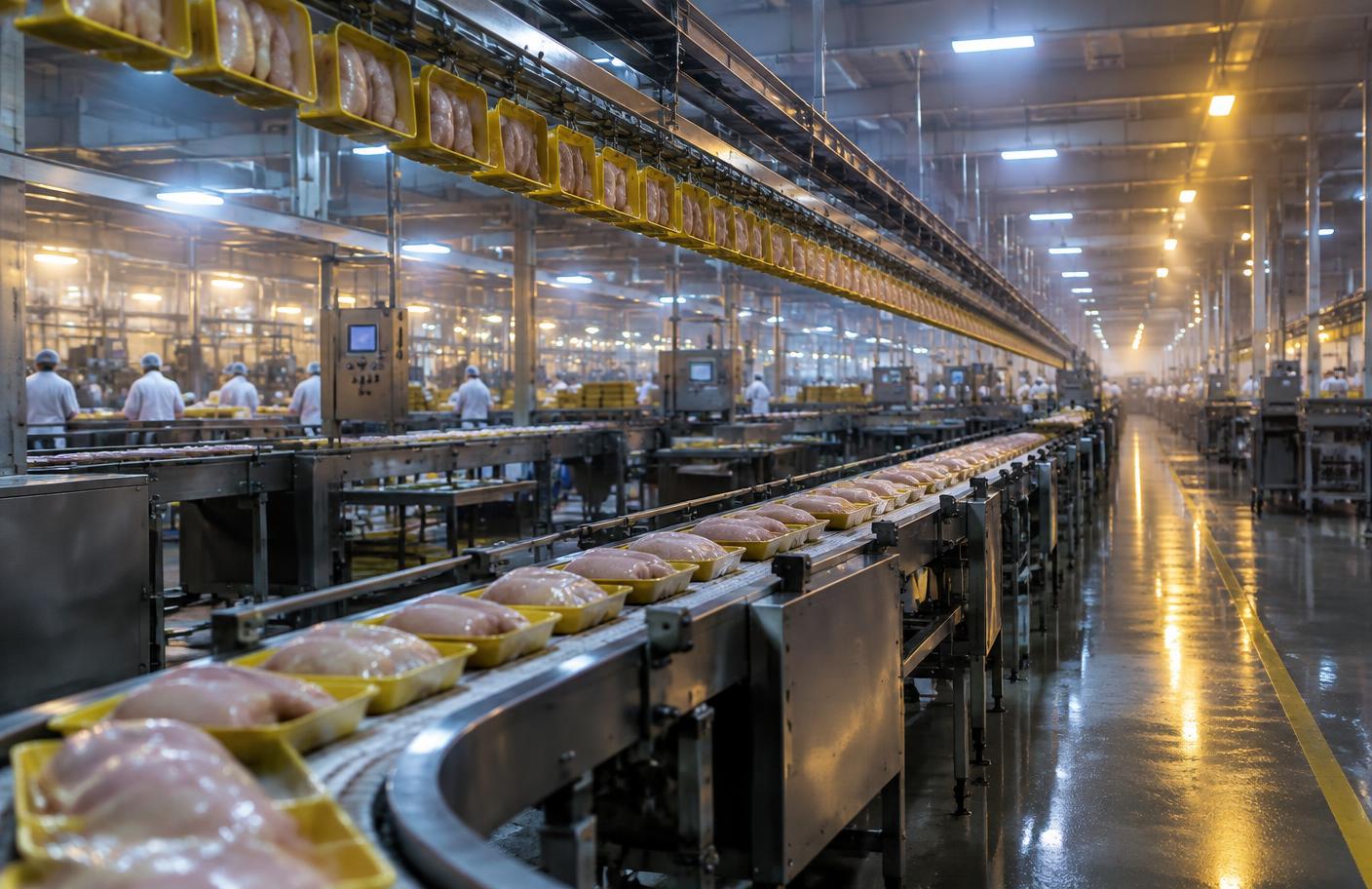
Ask who dominates the world broiler market and the honest answer is two lists. The first is short and stable: a small group of countries produces most of the meat, and a small group of companies moves most of the trade. The second list is longer and changes every few years: the producers climbing into the top tier, often on the back of state policy, cheap feed or a newly opened export market. Understanding both lists matters more than memorising either.
Field principle
Concentration at the top is real, but market share in chicken is earned at the border—disease status, halal capacity and freight costs decide who actually sells where.
The four production powerhouses
Four producers account for well over half of world broiler output. The United States is the largest single producer, built on vertical integration, cheap maize and soya, and a domestic market that eats more chicken per person than almost anywhere else. Brazil is the export machine: companies like JBS and BRF turned low feed costs and halal-certified capacity into a trade reach that covers the Middle East, Asia and Africa. China produces enormous volumes almost entirely for its own consumers, with giants like Wen's Food Group operating at a scale few Western firms match. The European Union rounds out the group—smaller in growth terms, but a high-value market shaped by welfare rules that increasingly set the terms of trade.
The pattern to notice is that production scale and trade power are not the same thing. China is a top-two producer but a modest exporter. Brazil produces less than the United States but ships far more abroad. A farm's competitive position depends on which game its country is playing.
The companies behind the tonnage
At company level, the market is strikingly concentrated. JBS, through its poultry arms, is the largest meat company in the world. Tyson Foods anchors the US industry alongside Pilgrim's Pride, Wayne-Sanderson and Perdue. Brazil's BRF and Thailand's Charoen Pokphand Foods (CPF) are genuinely global, with plants and brands across several continents. China's Wen's and New Hope operate at vast scale domestically. These firms share a model: they own or control the chain from feed mill to processing plant, and the farmer is usually a contracted grower rather than an independent seller.
For an individual grower, the practical meaning is that the 'market' is often one company. The integrator sets the chick, the feed, the schedule and the price formula. Knowing which firms dominate your region—and what alternatives exist, from other integrators to independent processing and direct sales—is basic commercial literacy.
The risers: where the map is being redrawn
The growth stories are elsewhere. Ukraine's MHP built one of Europe's largest poultry operations and held significant export share even through wartime disruption. Poland has become the EU's poultry engine, supplying much of Western Europe's imported chicken. In the Gulf, Saudi Arabia and the UAE are pouring state investment into domestic production to reduce import dependence—an opportunity for technology and equipment suppliers more than for exporters. Vietnam, Indonesia and the Philippines are expanding fast on rising domestic incomes. India, already a large producer, is industrialising quickly as demand shifts from live-bird markets toward processed and chilled product.
Two forces decide which risers actually arrive. The first is disease status: a single avian influenza outbreak can close export markets overnight, which is why biosecurity is trade policy. The second is certification—halal capacity, welfare standards and traceability systems are increasingly the entry tickets to the richest markets. Producers who treat these as core infrastructure, not paperwork, are the ones who move up the list.
What this means for a single farm
No farm competes with JBS, but every farm competes inside a structure these players shape. Import competition sets a ceiling on local prices; global feed markets set a floor under costs; and the integrator's contract defines the space in between. The useful response is not to track every headline but to know three things about your own position: who buys your birds and what alternatives you have, how exposed your input costs are to world grain and soya markets, and which certifications or standards would open a better-paying market segment.
Treat rankings and forecasts as ranges, not verdicts. Company revenues, national output and trade shares shift with currency, disease and politics. The stable advantage for a farm is the same as it has always been: low cost per kilo of saleable meat, a reliable buyer, and the flexibility to change course when the map is redrawn.