
The word broiler describes a job rather than a bloodline: a chicken raised for meat and harvested young, while the bird is still growing quickly and the meat is still tender. Everything else—feather colour, growth rate, cycle length, temperament, how much heat the bird can tolerate—follows from which type of broiler was chosen and what the farm can actually provide.
Field principle
Choose the bird your house, climate, feed supply and buyer can support. A faster strain only earns its potential when ventilation, water and feed quality can keep pace with it.
Broiler, layer, dual-purpose
Modern poultry is specialised. Layers are selected for sustained egg production on a light frame and are poor meat birds. Dual-purpose and local breeds grow more slowly and lay moderately, which suits mixed smallholdings. A broiler sits at the other end: selected for rapid muscle growth, efficient feed conversion, and the appetite and frame to carry that growth.
That specialisation is why broiler economics are so sensitive. A bird bred to grow quickly does not slow down gracefully when air, water or feed quality fall short—the gap shows up immediately as lost weight, poorer conversion and higher losses.
Why a commercial broiler is a hybrid, not a breed
Commercial broilers are terminal crosses produced by breeding companies through a pyramid of pedigree lines, great-grandparent, grandparent and parent stock. Male lines are selected mainly for growth, conformation and conversion; female lines carry more emphasis on egg numbers, fertility and hatchability. The chick a farmer places is the final cross.
This is why commercial broilers cannot be bred true on the farm. Saving birds from a broiler flock to raise a next generation gives inconsistent, less productive offspring, because the performance depends on the controlled crossing of lines the farm does not hold. Chick quality is therefore a purchasing decision, not something a grower can recreate.
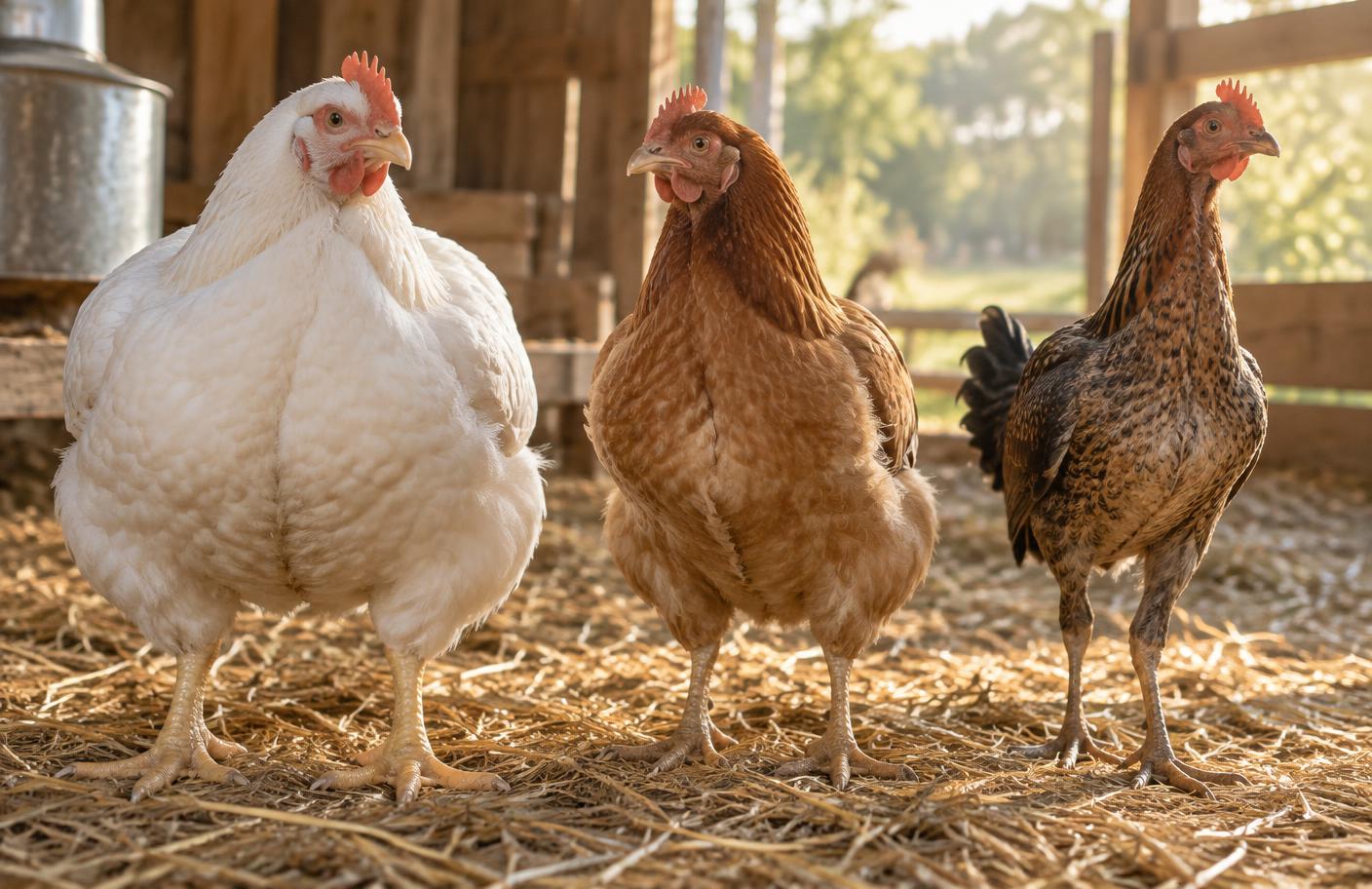
The historical ancestry of most modern broilers traces back to crossing broad-breasted Cornish-type birds with fast-growing Plymouth Rock-type birds. White feathering became the commercial norm largely because it leaves a cleaner dressed carcase, without dark pinfeather specks in the skin.
The main types of broiler
Conventional fast-growing hybrids—the Ross and Cobb families are the best known—dominate world production. They reach typical market weights in roughly five to six weeks with the lowest feed conversion of any type, but they demand good ventilation, constant water and consistent feed. In a hot, poorly ventilated house they are the least forgiving choice.
Slower-growing strains are bred for welfare-oriented and premium programmes. They take substantially longer to reach weight and eat more feed per kilogram gained, but they are more active, walk better and suit free-range or higher-welfare specifications where the buyer pays for the difference.
Rustic and tropical dual-purpose types—including improved smallholder birds and local crosses—grow slowest of all and convert feed least efficiently. Their advantage is robustness: better heat tolerance, better scavenging, lower dependence on climate control, and meat with a firmer texture that many regional markets prefer and pay for.
Pastured production often uses the fast-growing commercial cross in mobile housing at lower density. The genetics are conventional; the system, harvest age and finished product are not.
Market sizes are part of the type decision
The same strain becomes a different product depending on when it is harvested. Very young, light birds are sold whole as small single-portion chickens. Mid-weight birds are the retail and rotisserie workhorse. Heavier birds are grown for deboning, where the extra breast and leg yield carries the cost of the extra days of feed.
Later harvest weights always cost more per kilogram gained, because feed conversion worsens as the bird matures. The heavier bird pays only if the cuts it produces reach a market that rewards them.
Matching the bird to the farm
Start from the binding constraint. If ventilation, power reliability or water storage is the weak point, a hardier and slower bird will often out-earn a high-performance hybrid that cannot express its genetics. If the house is environmentally controlled and feed is consistent, the fast-growing hybrid is normally the most efficient use of every input.
Then check the buyer. Breed choice, harvest weight and cycle length should be settled against the specification and price you can actually be paid, along with local stocking-density and welfare rules. Breed standards published by the breeding company describe potential under their own management conditions, not a promise for every house.