
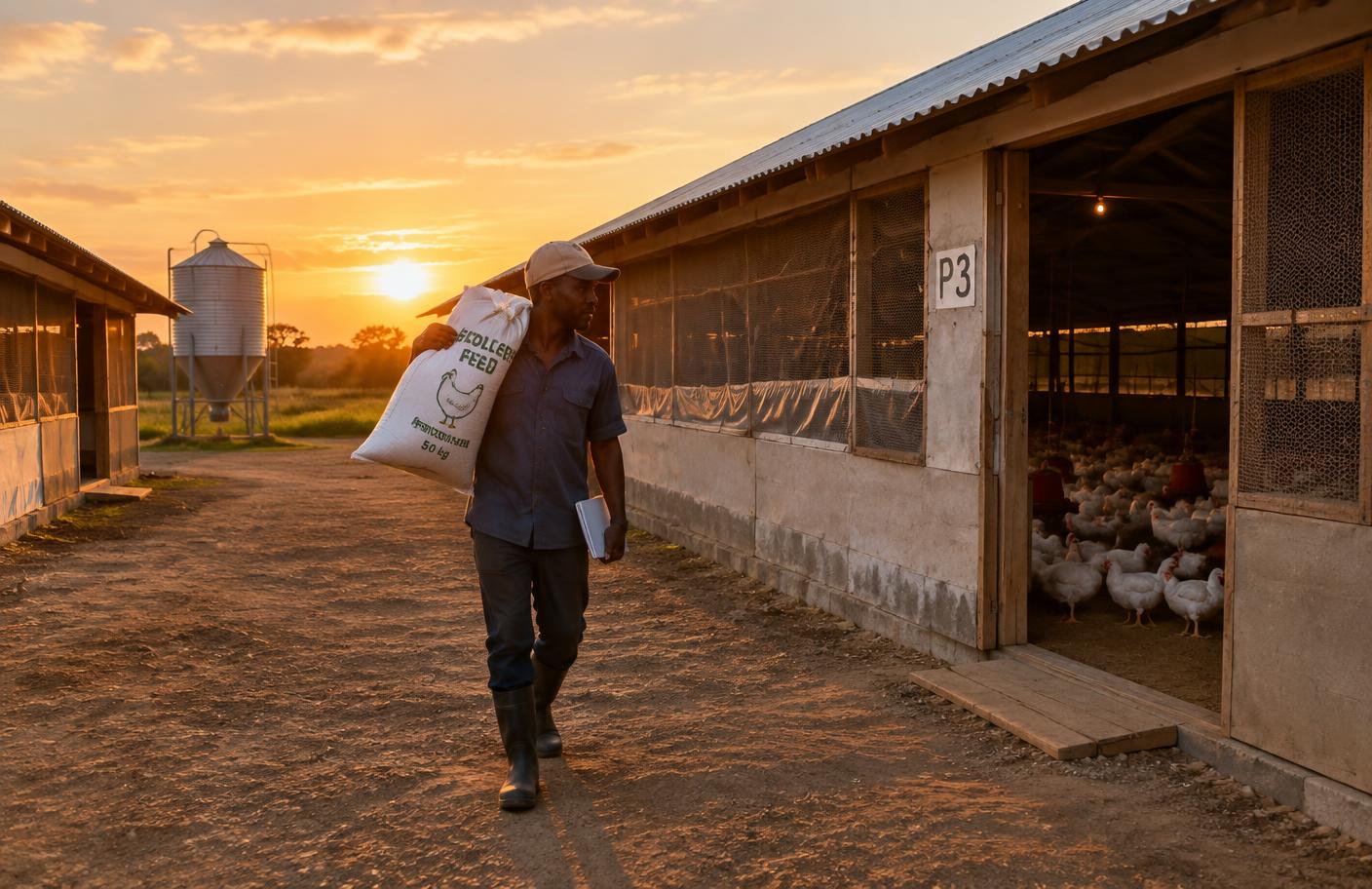
Every new grower asks the same two questions: how do I know if the flock paid, and when will I be good at this? The honest answers are less glamorous than the brochure. Broiler farming is a velocity business—money turns over every eight weeks or so—and the first year is tuition. Here is the arithmetic that separates a farm from a hobby, and the timeline that experience actually follows.
Field principle
Aim first for predictable, not perfect. A boring 330-EPEF cycle repeated six times a year out-earns one spectacular cycle followed by a disaster.
The three numbers that tell you if you are doing well
Start with gross margin per bird: what a sold bird brings in, minus the chick, the feed it ate, and the medication, bedding, power and labour allocated to it. If that number is not clearly positive, nothing else matters yet.
Then the efficiency score—EPEF, the European Production Efficiency Factor—which blends survival, weight, speed and feed conversion into one figure: livability percentage times average weight, divided by age in days times feed conversion, times one hundred. Under 280 you are bleeding cash; 300 to 340 is a solid smallholder standard; 350 to 390 is competitive commercial performance; 400 and above is the top decile globally.
Finally, return on working capital per cycle. Because a broiler cycle turns in about eight weeks including cleanout, the same money works six or more times a year. A modest margin per cycle, repeated reliably, compounds into a strong annual return on the cash you actually have deployed—provided you never lose a cycle outright.
The established precedents
Well-run commercial operations converge on a recognisable profile: first-week mortality under one percent, total mortality under four, feed conversion in the 1.5 to 1.7 range for standard weights, and EPEF above 350. Lenders underwriting a new broiler house typically model payback over four to seven years and look for steady mortality and margin per kilogram before anything else.
These are not ceilings; they are the reference points that tell you whether a cycle was ordinary, good or a warning. Compare your own numbers against them cycle by cycle, and against regional benchmarks where they exist, rather than against the best story you heard at the feed store.
Why the jackpot does not come in year one
The first two cycles are survival training. Expect breakeven or a small loss while you learn your house's hot spots, your water system's quirks and your own routines. The tuition is paid in dead birds and poor feed conversion, and every grower pays it.
Cycles three to five are standardisation: your routines settle, early mortality drops under one and a half percent, and EPEF climbs into the low 300s with modest, stable profit. Through year two you meet your first extreme weather—heat waves, cold snaps, power failures—and learn whether the house and the backup plan hold. By year three, with feed buying leverage, settled routines and records that show you what normal looks like, top-quartile performance becomes repeatable rather than lucky.
The practical rule: budget for about six cycles—a full calendar year—before you expect repeatable competence, and two to three full years before the process is optimised across every season. Anyone who promises faster is selling something.
Put your own numbers to work
The flock calculator on this site turns these ideas into your arithmetic: enter your chicks placed, mortality, weights, feed conversion and prices, and it shows the cost of the birds you lost, your margin per cycle, your EPEF, your yearly return and how many years the investment takes to pay back. Run it at two, five and ten percent mortality and you will see why the dead birds matter more than almost any other line.
Then keep records. The growers who reach the top quartile are not the ones with the best luck; they are the ones who can tell you exactly what every cycle did, and why.