
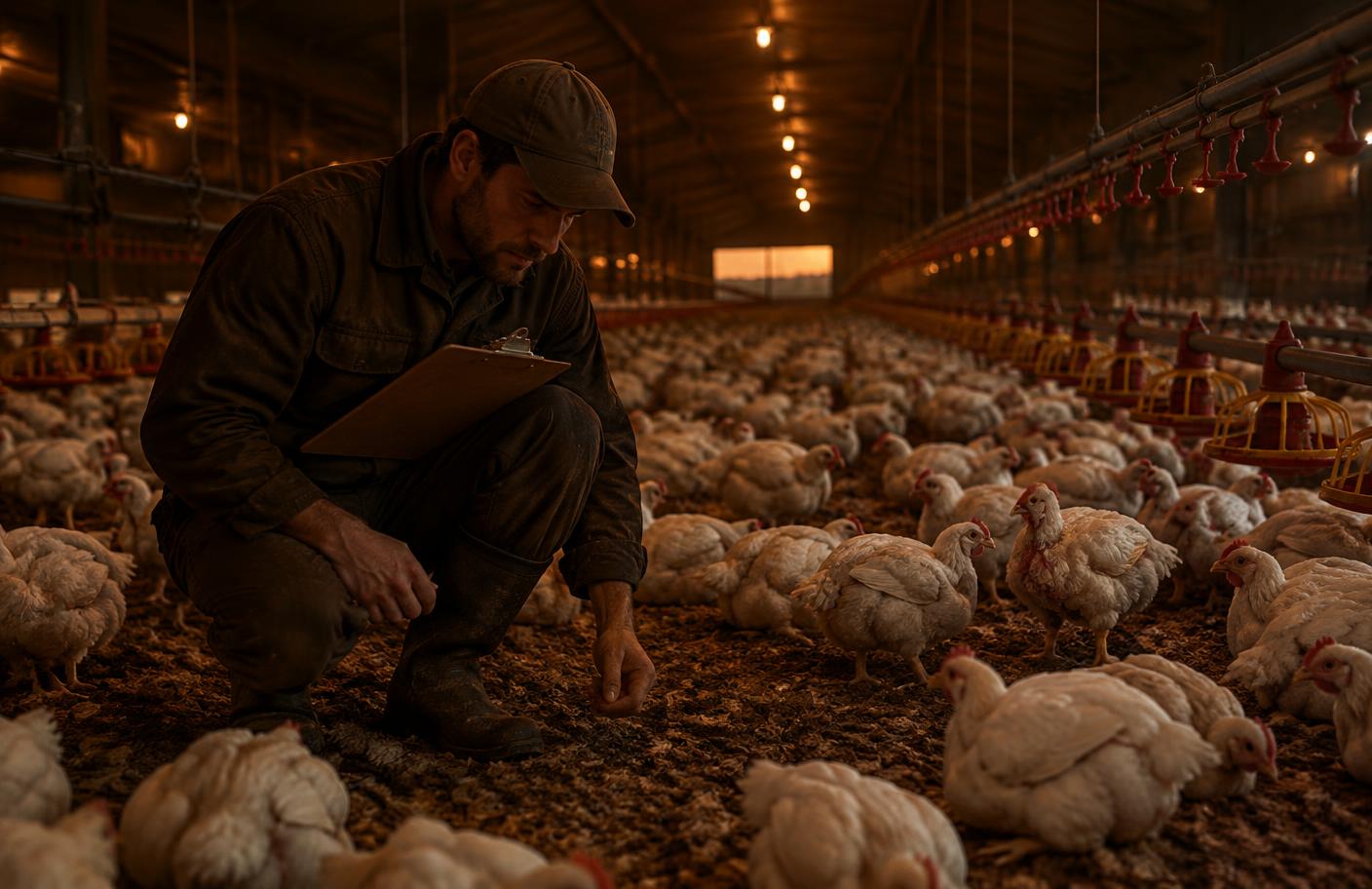
Every flock loses birds. The question is never whether mortality happens but whether you are counting what it actually costs. A chick that dies on day two is a lost purchase ticket. A bird that dies on day thirty-five has already eaten most of a full grow-out's feed, drunk thousands of litres of treated water, occupied heating and ventilation capacity for five weeks—and then disappears without leaving a single gram of saleable meat. You paid full price to feed a ghost.
Field principle
Mortality is not an animal-welfare statistic. It is a fixed-cost multiplier: every dead bird spreads your chick, feed, power and labour costs across fewer kilograms sold, while removing revenue at the same time.
The age of death decides the size of the loss
Not all dead birds cost the same. A day-three brooding loss has consumed little more than the chick price and a few grams of starter feed. A day-thirty-five finisher loss has consumed the chick, the vaccines, the heat, the labour and several kilograms of feed—and it dies just before it would have paid all of that back.
As a rule of thumb, a bird that dies in the final week costs roughly three times as much as one that dies in the first, once you count the feed it ate. That is why experienced growers read mortality by when it happened, not just how many. Three percent lost in week one points at the hatchery or the brooding setup. Three percent lost in week five is a financial emergency.
What different levels do to a flock
Run the same 1,000-bird cycle at different mortality levels and the pattern is stark. At two to three percent, losses are a rounding error and the margin holds. At five percent, you have given up the profit on roughly fifty birds plus everything they ate. At eight to ten percent on a thin-margin cycle, the dead birds and the sales they never made together can consume the entire profit of the cycle—the living birds end up working for the dead ones.
Each extra point of mortality costs you twice: once in sunk cost (chick, care, feed eaten) and once in lost revenue (the bird that is not there to sell). On a commercial house of tens of thousands of birds, a slide from three and a half to eight percent can bleed five figures of margin per cycle—often more than the house's entire annual maintenance budget.
Why your banker cares as much as you do
Lenders and integrators read mortality as a proxy for management. A grower with steady, low, well-recorded losses is a grower whose other numbers—feed conversion, weight gain, cost per kilogram—are probably also under control. Erratic mortality says the opposite, and it is priced into the loan, the contract or the placement decision.
In contract growing, erratic survivability gets penalised directly. For an independent grower seeking finance, a couple of points of unexpected mortality can erase most of the margin that was supposed to service the debt. Keeping daily mortality records is therefore not bookkeeping for its own sake—it is the evidence that lets you borrow, negotiate and improve.
What to do about it
In the first week, target under one percent cumulative loss. Check crop fill at eight and twenty-four hours after placement—nearly every chick should have a full, soft crop. Measure floor temperature on the litter surface, not at eye level, and hold the hatchery accountable if first-week losses cross one and a half percent.
Through the growing period, watch water before anything else: birds drink before they eat, so a dip in water consumption today is a feed dip tomorrow and a mortality spike the day after. Keep litter dry to suppress coccidiosis and enteritis. In the final weeks, manage growth velocity with lighting and ventilation so heavy birds do not succumb to heat stress or ascites.
Above all, count the dead every morning and write it down. The first week tells you about the chicks and the brooding; the last week tells you about the house; the trend across cycles tells you about yourself.